
Granted Projects
We take part in funded innovation projects that transform research into practical solutions
Our funded projects reflect Kerr’s commitment to applied research, technology transfer and collaborative innovation. We work with companies, research centers and institutions to develop advanced solutions with measurable industrial and social impact.

Investments for growth and employment ERDF 2014-2020
MEDSENS
Development of innovative sensors for vital signs detection in emergency medicine
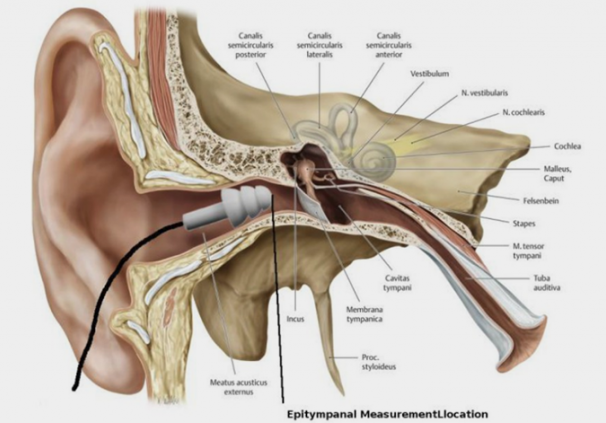
This project aims to develop a non-invasive device for emergency medicine and intensive care units capable of accurately detecting vital parameters such as body temperature, oxygen saturation, and pulse rate. Measuring these parameters represents a challenge for which fully non-invasive solutions are not yet available.
The objective of the project is to improve diagnosis, therapy, and treatment of acute patients and accident victims through the use of innovative technologies, thereby optimizing life-saving interventions.
The development of this medical device is based on studies conducted by the Institute for Mountain Emergency Medicine of the European Academy of Bolzano. According to these studies, the aforementioned vital parameters can be measured using a non-invasive measurement method.
The future device could significantly improve and simplify patient monitoring by integrating several devices currently used separately and replacing problematic invasive measurements with a safe and reliable non-invasive detection method.
In collaboration with research partners, the technical components and a prototype will be developed. To scientifically verify the validity and accuracy of the device, tests will be carried out in laboratory environments (terraXcube), in clinical settings (University of Innsbruck and University of Verona), and in field conditions.
After the development and validation phases are completed, the device will be prepared for market introduction.
Period: – 06/
Total cost: 602.251,64€
Total Contribution: 128.978,64€
Contact
Giacomo Strapazzon, MD, PhD
giacomo.strapazzon@eurac.edu
Web site
www.eurac.edu
Institute of Mountain Emergency Medicine

European Innovation Council (EIC) established by the European Commission, under the Horizon Europe programme (2021-27)
3D-BRICKS
3D Biofabricated high-perfoRmance dna-carbon nanotube dIgital electroniCKS
Silicon CMOS technology is reaching its performance limits, while the demand for more powerful computers — driven by the rapid evolution of applications such as the Internet of Things, big data, and artificial intelligence (AI) — continues to grow.
The discovery of new nanomaterials offers unprecedented opportunities for further developing information processing technologies. Among these materials, carbon nanotubes (CNTs) have demonstrated exceptional properties as channel materials in transistors. From a theoretical perspective, computers based on carbon nanotube field-effect transistors (CNT-FETs) could achieve a tenfold improvement in power–performance efficiency compared to computers based on conventional Si-CMOS technology.
However, the realization of high-performance CNT-based nanoelectronics and the full exploitation of their potential still represent a major challenge. A technological breakthrough would therefore be the development of a reliable method to fabricate a new family of CNT-based devices capable of achieving ordered nanotube alignment while avoiding the critical steps associated with nanolithography.
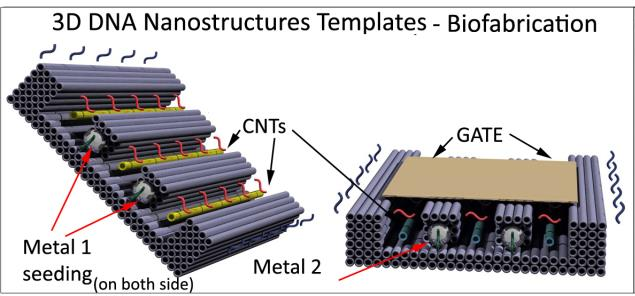
In particular, biofabrication using DNA-templated CNT arrays (DNA-templated CNT array FETs) has shown the potential to further improve the alignment of CNTs within FETs, overcoming the limitations of conventional lithography.
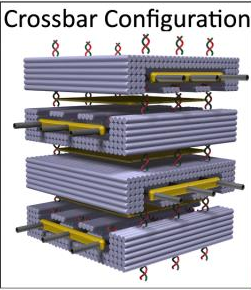
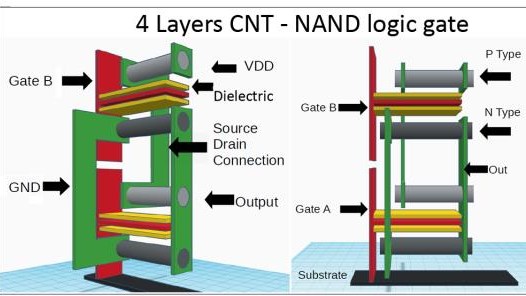
3D-BRICKS will take this concept of integrated self-assembly of CNT nanocircuits to an entirely new level by introducing the third dimension. The versatility of DNA nanotechnology will therefore form the basis for the design of three-dimensional (3D) CNT-FETs and CNT-based non-volatile memory devices.
DNA nanotechnology will also enable the integration of metal contacts during the CNT deposition process, allowing the fabrication of fully functional circuits. This approach will reduce the footprint of the final device while increasing its efficiency, offering a disruptive solution for the development of the next generation of nanoelectronics.
Our strategy will enable the scalable production of biotemplated electronics, extendable to multiple applications such as metamaterials, sensors, optoelectronics, and many others.
Period:
Total Contribution: 3.642.134,00€
Web site

Investments for jobs and growth ERDF 2021-2027
PIPO
Technological innovation in incontinence management
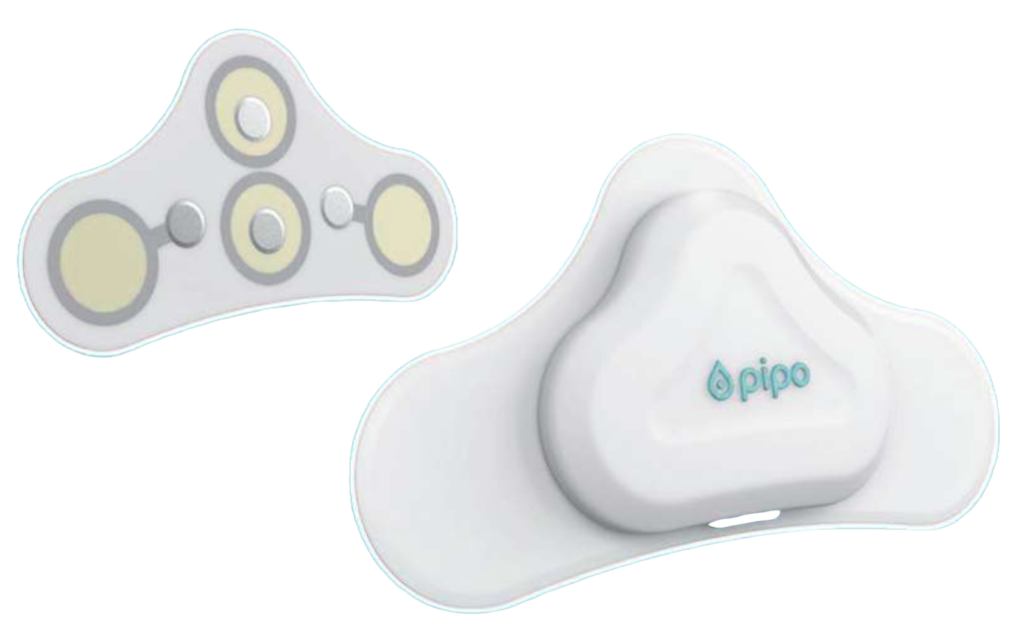
The PIPO project was created with the goal of revolutionizing the management of incontinence through a non-invasive technological solution, designed for people of all ages and capable of ensuring greater dignity, comfort, and quality of life. The system aims to replace a significant portion of disposable diapers and catheters, offering a more modern, intelligent, and environmentally friendly approach.
The project includes the engineering of the device for future production, together with the refinement of the artificial intelligence and machine learning algorithm that enables real-time monitoring and interpretation of the user’s condition. At the same time, the user experience of the app will be finalized, designed to communicate with the device in a simple and intuitive way across all major platforms (iOS, Android, and desktop) during the testing phases.
A key step will be the clinical evaluation, conducted both with patients affected by incontinence and with healthy individuals, in order to verify the effectiveness and reliability of the system. Alongside the technological aspects, PIPO places strong emphasis on social and environmental impact: reducing the use of disposable absorbent products contributes to global sustainability, while a more discreet management of incontinence significantly improves user well-being and privacy.
The project also promotes social innovation by involving caregivers and healthcare professionals, and aims to contribute to the reduction of healthcare costs associated with complications frequently linked to traditional diapers and catheters, such as infections and skin irritation.
In summary, PIPO represents an important step toward a new generation of personal well-being solutions, combining advanced technology, sustainability, and positive social impact.
Period:
Total cost: 445.171,04 €
Total Contribution: 267.102,62 €
Contact
Elisabeth Tocca
etocca@hotmail.com
Web site

PUBLIC CALL FOR THE SELECTION OF PROPOSALS, TO BE FINANCED UNDER THE INNOVATION ECOSYSTEM RESEARCH PROGRAM “I-NEST – INTERCONNECTED NORD-EST INNOVATION ECOSYSTEM”, USING THE RESOURCES OF THE NATIONAL RECOVERY AND RESILIENCE PLAN (PNRR), M4C2 – INVESTMENT 1.5. CREATION AND STRENGTHENING OF “INNOVATION ECOSYSTEMS FOR SUSTAINABILITY”, FINANCED BY THE EUROPEAN UNION, NEXTGENERATIONEU
SISLL
Development of an innovative lean lighting system with variable photometry and dynamic dimming based on luminance.
The project aims to develop, in support of well-being in mountain environments, an innovative solution capable of addressing issues related to public lighting, including road safety, light pollution, and energy consumption. This will be achieved through the development, design, implementation, and testing of a Lean Lighting system featuring dynamic dimming based on luminance measurement and variable photometries.
The individual components of the system will be developed and designed, including:
a control unit (with sensors and AI for monitoring weather conditions, traffic, and luminance),
a Lean lighting engine (power supply, LED strings, and optical system),
a dashboard for visualizing the operational parameters of lighting points, and
an installation app for configuring and managing the system.
The project addresses several crucial technical and scientific challenges, including the development of luminance recognition algorithms using optical sensors under different environmental conditions, and the integration of this technology into a control unit capable of adjusting different primitive photometries to achieve the most suitable in-situ lighting distribution.
The development process will begin with a phase of industrial research, aimed at defining the primitive optical configurations and identifying a reliable luminance measurement method using a fixed-focus optical sensor.
Once the design phase is completed, a system prototype will be built, followed by a testing period to validate its performance and reach a Technology Readiness Level (TRL) of 5–6.
Period:
Total cost: 324.651,25 €
Total Contribution: 180.121,42 €
Web site
Investments for jobs and growth ERDF 2021-2027
SMART-HUB
Innovative energy management system for integrated charging hubs with renewable energy
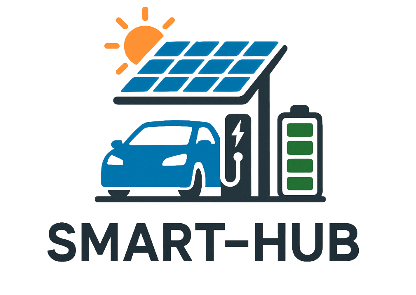
The SMART-HUB project aims to develop an innovative Energy Management System (EMS) for electric vehicle charging hubs, based on a hybrid approach that integrates Model Predictive Control (MPC) with Artificial Intelligence techniques.
The system will optimally manage the interaction between charging stations with different power levels, photovoltaic (PV) systems installed on canopies, and energy storage systems, maximizing the use of electricity generated from Renewable Energy Sources (RES) within the charging infrastructure. At the same time, it will increase the economic return for hub operators and provide dynamic pricing to users through smart charging mechanisms.
The project, which involves collaboration between Eurac Research, Alperia Green Future, NEOGY, and Kerr, will address the main challenges in the sector, including managing system complexity, real-time optimization of energy flows and renewable energy utilization, and handling uncertainties related to renewable generation and charging demand.
The proposed approach will overcome the limitations of current energy management systems, offering a scalable and replicable solution for the sustainable electrification of mobility.
Let’s develop your next electronic solution
Do not hesitate to contact us, we are here to help and advise you with the best solution.

Was founded in 2008 in Bolzano, Italy. It is sales representative for FarEast companies for microelectronic and lighting applications, with high capability in ASIC and FPGA design.